FIELD GUIDE 09
LLM vs.
generative AI
One term describes a language-focused model. The other covers a broader family of systems that generate content.
01 ExplainAI / field guide
The difference in one table
Understand the terms through a practical model-versus-system comparison.
NIST’s 2024 Generative Artificial Intelligence Profile describes generative AI as models that use the structure and characteristics of input data to generate derived synthetic content. The report is a risk-management profile, not a universal glossary for every context, but it illustrates why generative AI includes more than chatbots.
02 ExplainAI / field guide
Where do LLMs and generative AI overlap?
Understand the terms through a practical model-versus-system comparison.
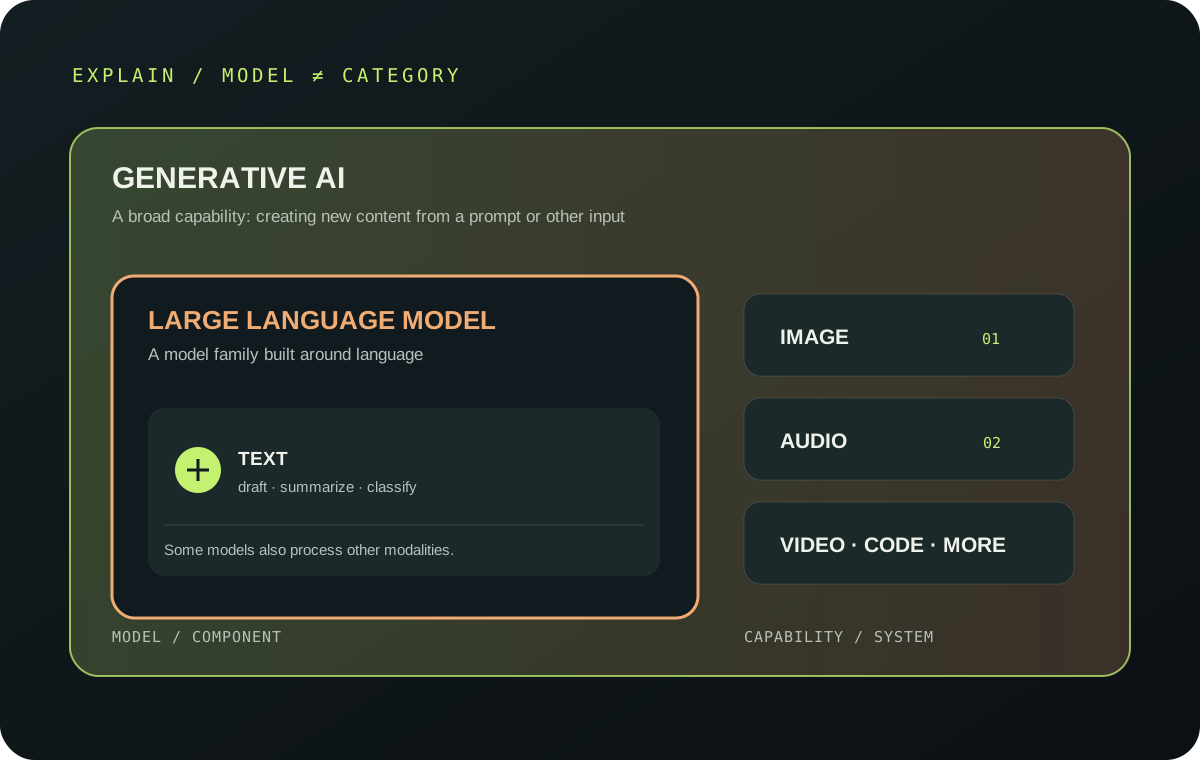
Imagine a large circle labeled generative AI. Inside it, one region contains language models that generate text. A text-generating LLM sits in that overlap.
The circles do not line up perfectly:
- An LLM used to label a review as positive or negative may be doing classification rather than generating new content.
- An image model can generate a picture without being a language model.
- An application may use an LLM to write instructions for a separate image model; the product is a generative-AI system with more than one component.
- A single model may take text and images as input, then return text. Its input and output types do not, by themselves, determine every technical detail of the model.
A useful mental shortcut is: ask what the model is built to process, then ask what the system is doing with it. Those are related but separate questions.
03 ExplainAI / field guide
Examples that make the distinction concrete
Understand the terms through a practical model-versus-system comparison.
“Write a short explanation of eclipses.”
A language model can turn a prompt into text. That is both LLM-based work and a generative use if the system is producing a new explanation. A chat interface around the model may also add instructions, conversation history or retrieval from a reference library.
“Create an illustration of a lunar eclipse.”
An image-generation model may produce pixels or a sequence of image-building steps. This is generative AI, but it is not automatically an LLM. The application might use an LLM to interpret the prompt and a different model to create the image.
“Label these support messages by topic.”
An LLM may classify each message into categories. The model is still an LLM, but the task is not necessarily generative: the system is selecting a label rather than composing a new passage. “LLM” does not mean “always writing prose.”
“Answer using this document and show the passage.”
A retrieval-augmented generation (RAG) system may search a document collection, supply relevant passages to a language model and present a response. The search and language generation are separate steps. Read our guide to how retrieval-augmented generation works.
04 ExplainAI / field guide
Why do people use the terms as if they were interchangeable?
Understand the terms through a practical model-versus-system comparison.
The first widely visible consumer tools often used language models in chat windows. Users saw an AI product write, summarize, translate and answer questions, so “generative AI” and “LLM” became shorthand for the same experience.
That shorthand hides important differences. A product may create an answer with a model, retrieve one from a database, route to a specialist model, or mix those steps. Meanwhile, image, audio and video generators may have little to do with language-model architecture. Asking which model or system is being discussed makes a comparison more precise.
05 ExplainAI / field guide
How to choose which term to use
Understand the terms through a practical model-versus-system comparison.
Use LLM when your point is about a language model or a language-focused task: model size, tokens, context windows, text output or language evaluation.
Use generative AI when your point is about content generation as a wider capability, particularly across modalities such as text, image, audio, video or code.
Use AI application or AI system when discussing a product’s complete behavior, including retrieval, external tools, safety filters and interface decisions. Do not attribute every feature of a chat product to the language model alone.
06 ExplainAI / field guide
Important limits of the shorthand
Understand the terms through a practical model-versus-system comparison.
These terms do not tell you whether a model is accurate, safe, current, private or suitable for a job. A model can write fluently and still give a wrong answer. A system can create plausible media and still make important details up. The risk depends on the model, its data, the way the product uses it and what a person does with the output.
Likewise, the label does not tell you that an answer came from a particular website or that a model checked its sources. A RAG system may show retrieved passages, but you still need to verify whether those passages support the conclusion.
07 ExplainAI / field guide
Sources
Understand the terms through a practical model-versus-system comparison.
- NIST AI 600-1: Generative AI Profile — NIST’s 2024 risk-management profile and its scope for generative AI.
- NIST: AI Risk Management Framework — overview of the Framework and companion generative-AI profile.
FAQ Model terms / quick answers
Questions,
answered.
Clear distinctions without treating a product as a single model.
Is ChatGPT an LLM or generative AI?
The product is an AI system, not just one model label. It may use language models and other system components. When it generates text or images, that is generative-AI functionality; an LLM is a model component that processes language.
Are all LLMs generative AI?
No. LLMs can be used for tasks such as classification, extraction or ranking that do not generate new content. Many LLMs can generate text, but the term “LLM” alone does not describe the task being performed.
Is generative AI the same as artificial general intelligence?
No. Generative AI refers to content-generation capabilities. The term does not mean that a system has general human-like understanding or can perform every intellectual task.
Are image generators LLMs?
Not automatically. An image generator may use a model designed to create images. A larger product may pair that image model with an LLM that interprets or rewrites a text prompt.
What is the simplest way to remember the difference?
An LLM is a type of language-focused model; generative AI is a broader category based on generating content. They overlap when a language model creates text.