FIELD GUIDE 10
Build a large language model
from scratch.
Follow the real pipeline: curate text, tokenize it, train a transformer to predict tokens, then test what it learned.

01 Start here / the scope
What “from scratch”
actually means.
Separate the educational goal from the infrastructure behind a production model.
Building a large language model from scratch means defining a language-modeling task, preparing a text corpus, choosing a tokenizer and architecture, initializing model weights, training those weights, and checking the result on data the model did not train on. A common objective is causal next-token prediction: given a sequence, estimate the next token.
The phrase does not automatically mean that you wrote every kernel, created a tokenizer algorithm or invented the transformer. A project can train new weights while using existing frameworks and a published tokenizer. Say exactly which parts are new. Training a small educational model is a useful way to learn the loop; it does not reproduce the data, compute, evaluation or safety work behind a modern production system.
Pretraining starts with a broad corpus and learns general token patterns. Fine-tuning starts from existing weights and adapts them. If you load a pretrained checkpoint, you are no longer training the base model from random initialization.
02 The whole workflow
From raw text
to a tested model.
Each stage sets constraints for the stage after it.
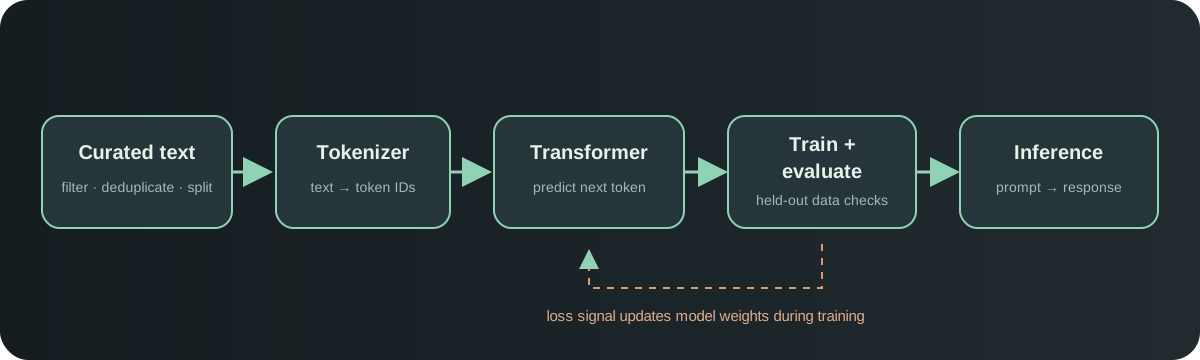
- Define the use and boundary. Decide the language, domain, expected output, acceptable latency and risks. This determines the data, context length and evaluation tasks.
- Build a lawful, documented corpus. Collect text you have rights to use, record provenance and filter out material that should not be included. Remove duplicates and split documents before generating training examples.
- Map text to tokens. A tokenizer normalizes text and converts it into token IDs. A token may be a word, part of a word, punctuation or a byte-level unit. The tokenizer’s vocabulary and special tokens must match the model’s input layer.
- Choose a model and objective. A decoder-only transformer is a common choice for autoregressive text generation. Select dimensions, context length, parameter count and training objective that your data and hardware can support.
- Train and monitor. Feed token sequences in batches, ask the model to predict the next token, calculate a loss, then use gradients and an optimizer to update weights. Track training and validation loss as the run proceeds.
- Evaluate and document. Test on held-out examples and task-specific checks. Inspect failure cases, record the training setup and describe limits before anyone relies on the output.
03 Data / quality and rights
Prepare the corpus
before scaling.
More text is not automatically better data.
Write a data policy before downloading a large collection. Record where each source came from, its license or permission, language and date. Filter corrupted text and obvious boilerplate, remove duplicates, and check for private or sensitive information. Keep a small, human-inspected sample so you can see what the pipeline is actually feeding to the model.
Split the corpus into training, validation and test sets at the document or source level before slicing long documents into context windows. If near-duplicate passages appear in both training and test data, a score can look better without showing that the model generalizes. Keep the test set protected until the model and evaluation choices are fixed.
For a first learning run, use a small dataset with clear provenance and a narrow objective. Do not scrape sites indiscriminately or assume that public availability grants permission to train on the content.
04 Tokenizer / architecture
Choose parts that
fit together.
The vocabulary, model inputs and sequence length form one contract.
Tokenizer is not the model
A tokenizer learns or applies rules for dividing text into tokens and mapping them to IDs. Training a tokenizer is a separate statistical task from updating neural-network weights. You can begin with a compatible existing tokenizer; train a new one only when the language, domain or vocabulary makes that choice useful.
Before training, inspect example strings, token counts, unknown or unusual symbols, and how the tokenizer handles whitespace and code. The model’s embedding table must be sized for the tokenizer vocabulary, and the same tokenizer must be used when preparing training and inference prompts.
Transformer and next-token prediction
The original Transformer paper introduced an attention-based architecture without recurrence or convolution. Many generative language models use a decoder-only variant with causal attention, so the model can use preceding tokens while predicting the next one. Each training example is a sequence of token IDs; the target is the same sequence shifted by one position.
Context length controls how many preceding tokens can be considered in one sequence. It affects memory use and the kind of dependencies visible to the model. Increasing it is not a free quality upgrade: it changes data packing, compute and evaluation requirements.
If these terms are new, review how a transformer processes a sequence and how text becomes LLM tokens before choosing model dimensions.
05 Training / compute
Run a small experiment
you can explain.
A reproducible baseline teaches more than a large run you cannot diagnose.
At a high level, each batch passes through the model, produces next-token logits, and is compared with the target tokens using a loss function. Backpropagation computes gradients; an optimizer applies an update to model weights. Repeat across batches and training steps, while checking the validation loss and sample outputs at controlled intervals.
Log the model configuration, data version, tokenizer version, random seed, optimizer settings, batch and sequence sizes, software versions, hardware, checkpoints and evaluation results. Save checkpoints safely and make a short run reproducible before increasing the dataset or model.
Memory and training time depend on model size, sequence length, batch size, precision, optimizer state, hardware and implementation. There is no honest universal laptop specification or training-time promise. Start with a tiny model and a small permitted corpus; measure the actual resource use on your setup. Hugging Face’s causal-language-model course provides a concrete example of tokenizing, grouping sequences and using labels for a next-token objective.
If training loss improves while validation loss stalls or worsens, the model may be overfitting or the data split may not match the task. A fluent sample is not evidence that a model is accurate.
06 Evaluation / limits
Test more than
a good-looking sample.
Measure the behavior you intend to use.
Keep evaluation data separate from training. Pair general language-model metrics, such as held-out loss or perplexity when appropriate, with tasks that resemble the intended use. Review examples for factual errors, repetition, memorized passages, unsafe completion patterns and sensitivity to prompt wording. Automated scores are signals, not a substitute for inspecting the failure cases.
Document what the model was trained on, what it was not tested on, and what a user should not assume. A base model trained to predict text is not automatically an assistant, a fact checker or a safe application. Instruction tuning, retrieval, moderation, user interface and human review are separate system decisions. For the retrieval step, see the RAG guide.
07 First project / scope
Build a learning model
in sensible stages.
Use a sequence that exposes one new idea at a time.
- Implement or inspect a tiny next-token model on a small, licensed text corpus.
- Print tokens and model inputs so you can trace one example end to end.
- Train a small decoder-only transformer and plot training versus validation loss.
- Generate short samples with a fixed prompt and record where they fail.
- Change one variable at a time—data, context, tokenizer or model size—and compare results.
Our neural network from scratch with Python explains the learning loop at a smaller scale. For a broader sequence of concepts, start with the machine-learning beginner course. Those guides are stepping stones; the full language-model pipeline adds data governance, tokenization, sequence modeling and much heavier compute.
FAQ Training / quick answers
Questions,
answered.
Keep the scope of a from-scratch project precise.
Can I build a large language model from scratch on a laptop?
You can build a small educational language model on a laptop, depending on its memory and software setup. Training a capable, general-purpose LLM is a different scale of data, compute and engineering; do not assume a tutorial-sized run will reproduce a production model.
What does “from scratch” mean for an LLM?
It usually means initializing model weights and training them on a corpus rather than starting from pretrained weights. A project may still use existing software libraries, hardware and a pretrained tokenizer, so state clearly what is and is not being trained from scratch.
Do I need to train a tokenizer from scratch too?
Not always. A compatible pretrained tokenizer can be used for learning or domain adaptation. Training a new tokenizer is a separate task and is useful when the language or corpus needs a different vocabulary.
How is pretraining different from fine-tuning?
Pretraining learns general next-token patterns from a broad text corpus. Fine-tuning continues training from existing model weights on a more specific dataset or objective. Fine-tuning is not the same as building the base model from random initialization.
08 Source notes
Read the
primary references.
These sources support the architecture, tokenization and training workflow described above.
- Vaswani et al., “Attention Is All You Need” — the original Transformer architecture paper.
- Hugging Face course: Training a new tokenizer — explains tokenizer training as a separate task from model training.
- Hugging Face course: Training a causal language model from scratch — a worked educational workflow for tokenization, sequence grouping and training.
- NIST AI Risk Management Framework — a reference for managing and documenting AI-system risks.
Technical review: October 5, 2026. Frameworks evolve; check the current documentation for version-specific APIs.